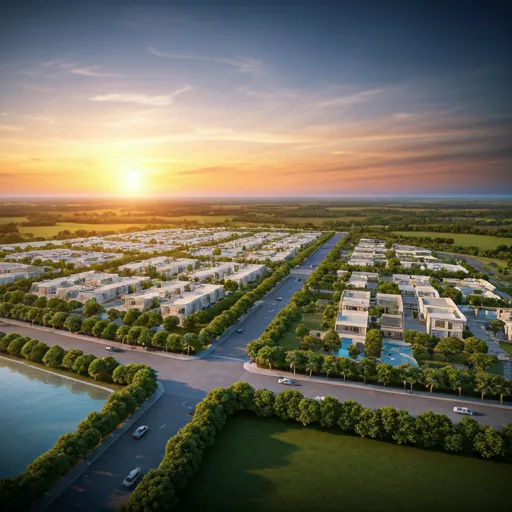
“I have always believed that when it comes to real estate, you should watch where the infrastructure is going before you watch where the prices are going.”
That is why the recent announcement around the Adani Group’s plans for Mumbai and Navi Mumbai caught my attention.
According to recent reports, around 70% of the first phase of Adani’s Airport City investment of more than ₹20,000 crore is concentrated around Mumbai and Navi Mumbai. Around 440 acres near the two airports are being planned as connected districts with business, hospitality, retail, entertainment and public spaces. The group is also looking at significant development around airports and city-side infrastructure over the next 15–20 years.
These are big numbers. But numbers are not what interest me most.
What interests me is why this region is attracting this kind of commitment.
Mumbai is changing direction
For many years, when we spoke about Mumbai real estate, most conversations remained within Mumbai itself.
Then Navi Mumbai started becoming important.
Today, the map is expanding again.
The Navi Mumbai International Airport, Atal Setu, JNPA, new road and rail links and the larger Mumbai 3.0 plan are gradually changing the importance of the entire region on the other side of the harbour.
The Scale of Mumbai 3.0
Mumbai 3.0 itself is being planned across 323.44 sq. km and 124 villages in Panvel, Uran and Pen, with residential, commercial, institutional, industrial and logistics-led development forming part of the larger vision.
This is why I don’t see Mumbai 3.0 as simply another real-estate project.
It is potentially a new economic zone.
An airport is never only an airport
People often look at an airport and think about flights.
A developer looks at it differently.
An airport brings people. It brings companies. It brings hotels, logistics, warehouses, offices, transport, restaurants, retail and employment.
Then people need homes closer to these jobs.
Schools come.
Hospitals come.
Commercial activity grows.
And slowly, an area that was once considered far away becomes part of the mainstream city.
That is why Adani describing the Mumbai and Navi Mumbai airport developments as economic gateways for Mumbai 3.0 is significant.
It tells us where some of India’s biggest infrastructure players believe future economic activity can develop.
Uran, Panvel and Raigad cannot be looked at the old way anymore
I have met many people who still judge Uran or parts of Raigad based on how these areas looked five or ten years ago.
That is a mistake.
Real estate should not only be judged by what is standing there today.
You have to understand what is connecting to it tomorrow.
The Atal Setu has already changed connectivity between Mumbai and the mainland. Navi Mumbai International Airport is another major anchor. JNPA has been there as one of India’s most important logistics gateways. And now Mumbai 3.0 is bringing a much larger planning vision to the region.
MMRDA has also formally moved ahead with the master-planning exercise for Mumbai 3.0.
When multiple pieces of infrastructure begin coming together, the character of a location can change.
But there is another side to this story.
Big announcements do not mean every plot is a good investment
This is something I repeatedly tell people.
Please don’t purchase land simply because someone shows you an airport on Google Maps or says, “Adani is coming here.”
That is not due diligence.
-
1
Check the title: Ensure 100% clear, unencumbered, marketable title with verified legacy ownership history.
-
2
Check the 7/12 extract: Scrutinize Ferfar (mutation entries), ownership names, and encumbrance certificates.
-
3
Understand access to the plot: Physical road access and sanctioned legal approach are non-negotiable.
-
4
Understand what is actually proposed: Study the official MMRDA regional plan rather than broker brochures.
-
5
Check applicable development rules: Verify NA 44 zoning, FSI sanctions, and reservation statuses.
-
6
Verify price sanity: Most importantly, understand whether the price you are paying makes financial sense.
What Adani’s move tells me
For me, the biggest takeaway from this news is quite simple.
Serious capital is looking beyond today’s Mumbai.
Companies making investments of this scale are not planning for next year. They are studying where people, businesses and economic activity may move over the next 10, 15 or 20 years.
A retail investor doesn’t have to blindly follow them.
But we should certainly understand what they are seeing.
Mumbai has always reinvented itself when it runs out of space.
Mumbai 3.0 may be the next such reinvention.
I would therefore not look at this simply as an Adani story.
I would look at it as another indication that the economic centre of Mumbai is gradually becoming wider—and Navi Mumbai, Uran, Panvel and the surrounding Raigad belt are becoming increasingly important to that story.
The opportunity may be there.
But as always, my advice remains the same:
“Study the location. Study the documents. Understand the infrastructure. Then invest.”

About Binod Agarwal
Binod Agarwal brings 16 years of service in the Indian Armed Forces and over 26 years of real estate, governance, and business experience across Navi Mumbai and Maharashtra. His philosophy has always anchored in clear titles, ground verification, and long-term generational wealth.